Import and Reuse: A Faster Way to Set Up Meetings

You’ll see a BETA label next to the new Import feature—this indicates it’s version 1 of a tool we plan to expand and refine over time. cAdmin’s Import feature lets you pull in lists, session types, activities, campaigns and more from any past meeting—no rebuilding from scratch.

BETA Notice

You’ll see a BETA label next to the new Import feature—this indicates it’s version 1 of a tool we plan to expand and refine over time. It’s functional and ready to use, though you may notice a few rough edges as we gather feedback and shape future enhancements.

Overview

cAdmin’s Import feature lets you pull in lists, session types, activities, campaigns and more from any past meeting—no rebuilding from scratch. By reusing proven configurations, you slash setup time and costs, reduce manual data-entry errors and enjoy the flexibility to mix and match only the components you need for each meeting.

Who Can Use It

All cAdmin roles have access to Import, except for Freelance Onsite AV Staff & Vendors.

Where to Find Import

Homepage: Click Import in the upper-right corner.
Individual Dashboards (Lists, Activities, Campaigns, etc.): Click Import on that dashboard to copy only those settings.

What You Can Import

1. Lists
2. Custom Terms
3. Session Types
4. Activities
5. Campaigns
6. Extra Data Fields
7. Media Types
8. Collection Templates

Full Import Wizard (All‑in‑One)

1. Initiate Import
• From the homepage, click Import (upper right).

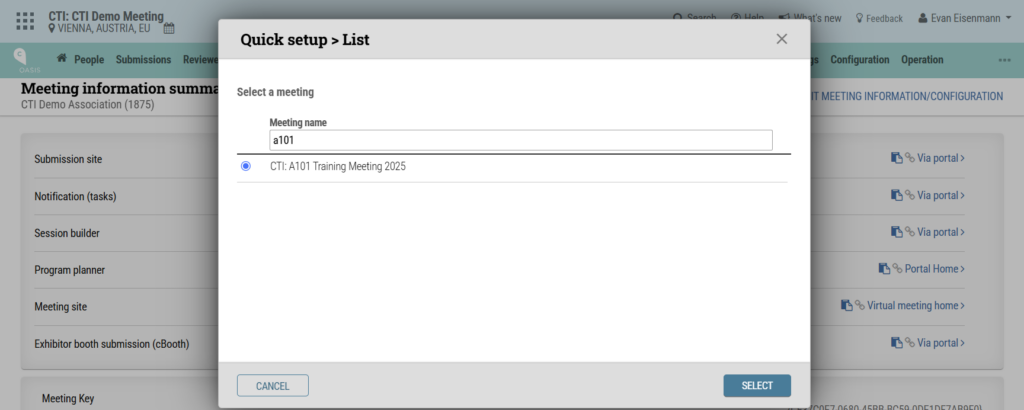
2. Select Source Meeting
• Choose the meeting whose settings you want to copy.
• Use the search bar to filter by meeting name or date.
3. Step Through Each Setting
Lists
Skip if you don’t need them.
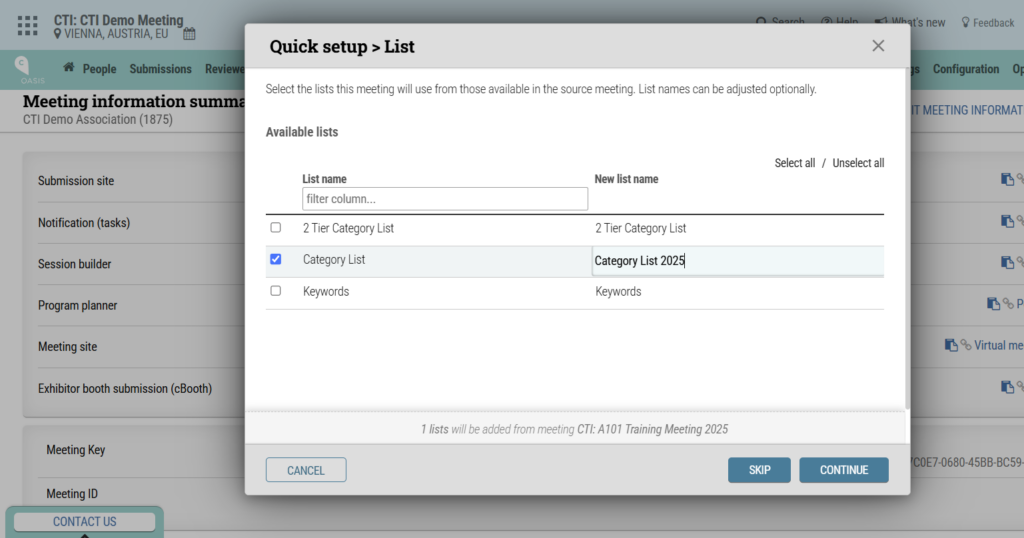
• Select any list to copy. When you do, its row may highlight yellow—this indicates that a list with the same name already exists in the new meeting. You must rename it in the New list name field (e.g., “Category List” → “Category List 2025”), otherwise the import won’t allow duplicate names.
Custom Terms
• Check the terms to import and adjust each “Meeting level value” as needed.
• The running footer at the bottom of the dialog box reminds you which meeting you’re copying from.

Session Types, Activities, Campaigns, etc.
• Follow the same pattern: skip or select, then rename or update as desired. Any selection that conflicts with an existing name will highlight yellow, signaling you to provide a new name before proceeding.

4. Review & Confirm
Click Continue at each step to confirm or skip the import.

5. Verify
After completing the wizard, visit each dashboard to ensure your imported settings appear correctly.

Quick-Pick Imports

If you only need one setting (e.g., an activity):
1. Navigate to the relevant dashboard (e.g., Activities) and click Import.
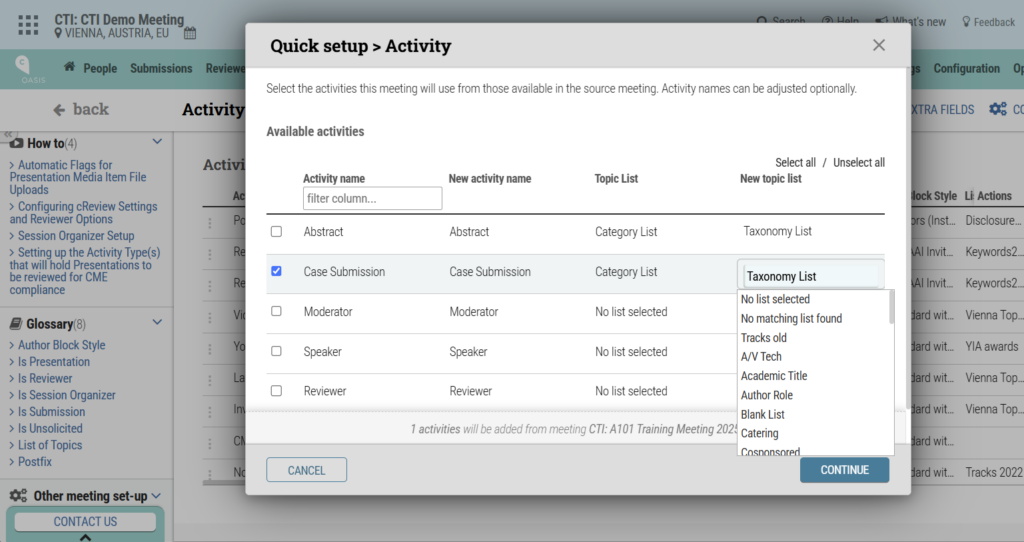
2. Select your source meeting and the specific item(s) you want to bring in. The selected row will highlight yellow if its name already exists—rename it to avoid conflicts. For activities, you can also choose a New topic list.
3. Click Continue to confirm the import.
Benefits

Time & Cost Savings: Reuse proven configurations rather than rebuilding from scratch.
Error Reduction: Minimize manual data-entry mistakes.
Flexibility: Mix and match only the components you need for each meeting.
Session Room

While the CTI Presentation Management Application is a cloud-based application, CTI can also provide hardware for onsite meetings. This includes laptops for the Speaker Ready Room (SRR), enabling speakers to upload, edit, and preview presentations, and laptops for the session rooms for speakers to access, navigate, and speak through their presentations.

Session and Presentation Time Calculations

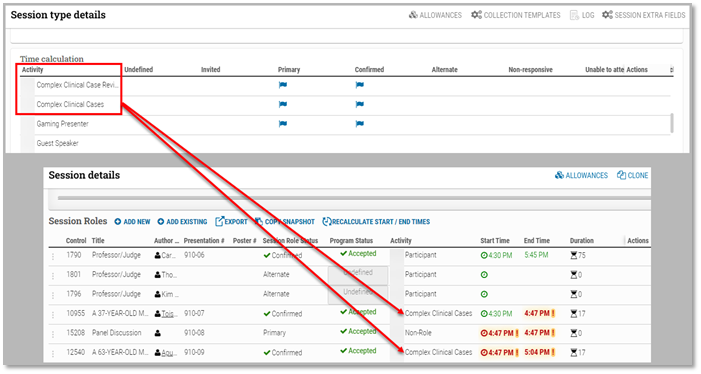
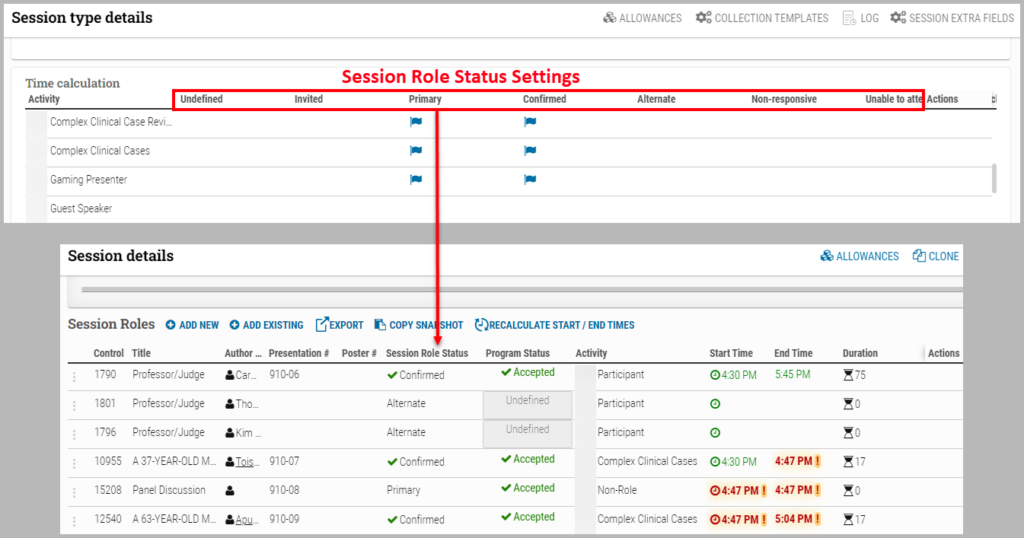
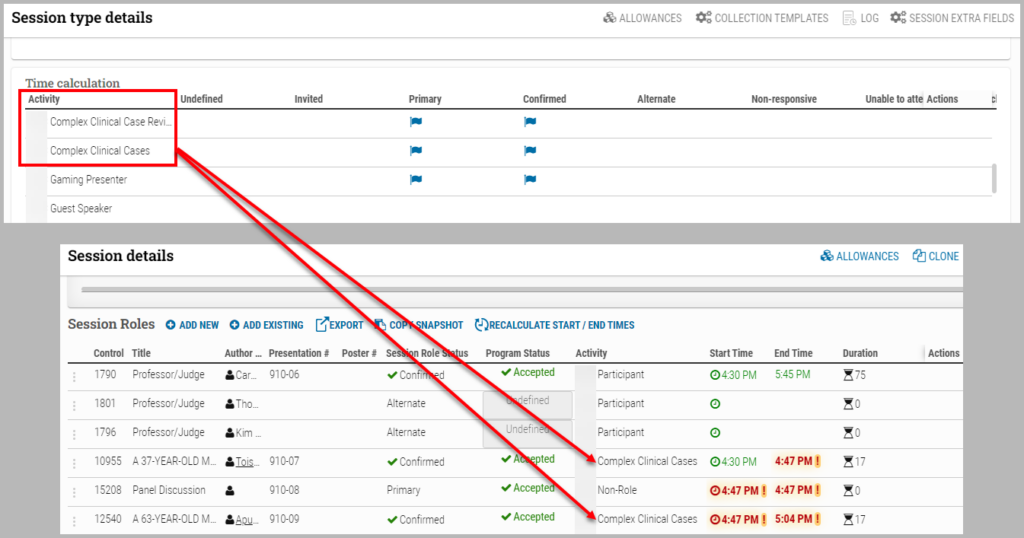
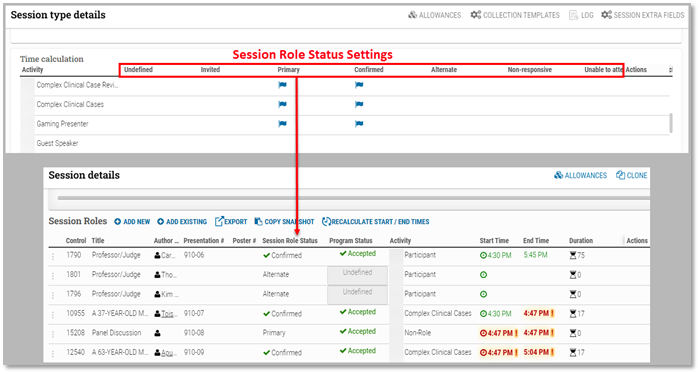
An administrator can determine whether an activity should be incorporated into the session role’s start and end time auto-recalculation. Checking flags includes the activity and session role status in the presenter time calculations in Session details.

An administrator can determine whether an activity should be incorporated into the session role’s start and end time auto-recalculation under:
1. cAdmin > Sessions
2. Session types
3. Session type details (Time calculation is at the bottom).

Checking flags includes the activity and session role status in the presenter time calculations in Session details. Leaving flags unchecked means the session role times will be “display only” – allowing you to set times for those session roles manually (e.g., Chair, Moderator) that will not affect the calculated presentation times.

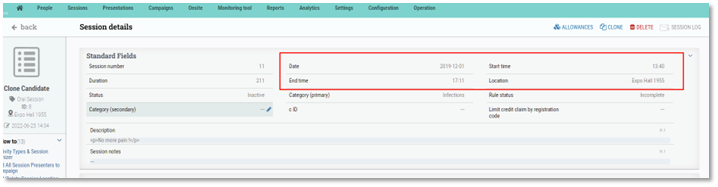
Start and End Times outside of the Session Start/End Time will turn red (image above), alerting the administrator of an issue. To correct the problem, either manually change the Start/End time by clicking and changing or, if the administrator sets up the Time calculations explained above, selecting “Recalculate Start/End Times.”

Time Calculation Session Roles

Administrators can determine whether an activity should be incorporated into the session role’s start and end time auto-recalculation.

Checking flags includes the activity and session role status in the presenter time calculations in Session details.

Leaving flags unchecked means the session role times will be “display only” – allowing you to set times for those session roles manually (e.g., Chair, Moderator) that will not affect the calculated presentation times.

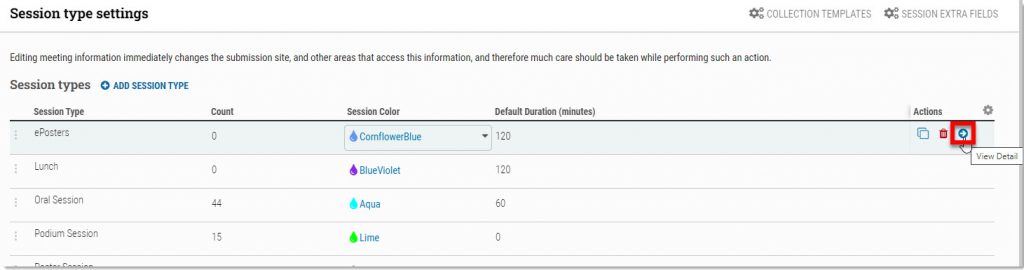
To view Time Calculations, go to Settings > Sessions > Hover over a Session type and click the details arrow.


Session Organizer Setup

Administrators can view and edit a presentation to roles other than the presenter. Like a presenter, permitted roles can access the presentation through the Portal to check for quality control. Another level of edit permission enables them to make changes to the presentation as well.

Administrators can view and edit a presentation to roles other than the presenter. Like a presenter, permitted roles can access the presentation through the Portal to check for quality control. Another level of edit permission enables them to make changes to the presentation as well.  This functionality has been commonly requested by on-site presentation management customers and is beginning to be requested by customers organizing hybrid and virtual meetings as a tactic to reduce the cost of external A/V labor.

To assign an activity as a Session Organizer:
1. Hover over the activity type under Submissions -> Activities.
2. Click the Edit icon.
3. Check the Is Session Organizer box.

Additional Information for Submissions: For submissions to show up on the Submissions tab, “Is Reviewer” and “Is Session Organizer” need to be unchecked. 

Color-Coded Session Scheduler

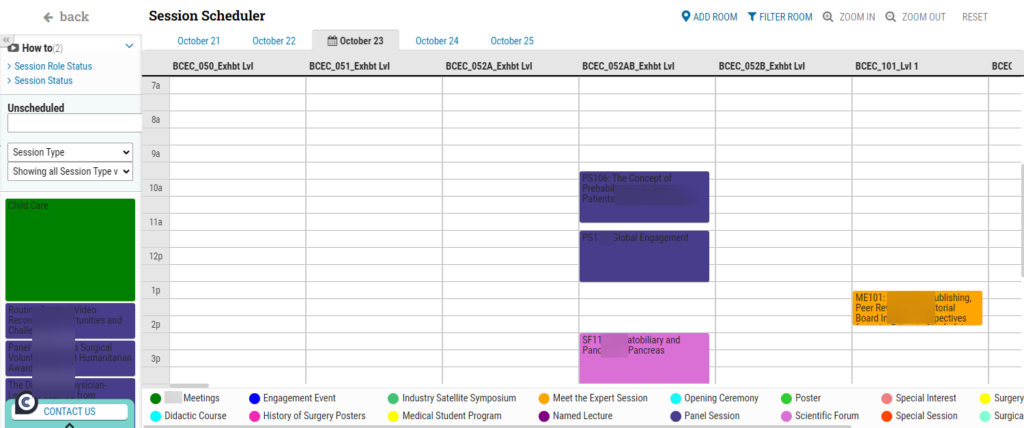
Colors in the Session Scheduler organize filter types, with the Session type filter being the most common. Each Session type has an assigned color on the grid, aiding schedulers in quickly assessing programming variety and highlighting special needs sessions.

Colors in the Session Scheduler organize filter types, with the Session type filter being the most common. Each Session type has an assigned color on the grid, aiding schedulers in quickly assessing programming variety and highlighting special needs sessions.